
Información sobre el cáncer de mama para las pacientes y los profesionales sanitarios que las atienden.
Aprende por tu cuenta. Explora juntos durante una sesión de tratamiento. Comparte recursos confiables con alguien a quien aprecias.
Acerca del cáncer de mama y el dolor
¡Nos alegra mucho que estés aquí!
Esta formación en neurobiología del dolor se creó pensando en ti. Gracias a mi trabajo como fisioterapeuta oncológica —y a mi propia experiencia con dolor torácico intenso tras mastectomías preventivas, migrañas crónicas y más de 20 años de dolor en las piernas tras una lesión de espalda— he aprendido lo complejo y personal que puede ser el dolor. Estas experiencias han moldeado tanto mi práctica clínica como mi pasión por aprender, enseñar y compartir lo que realmente ayuda. Mi objetivo es utilizar mis conocimientos para reducir el sufrimiento y ofrecer esperanza a quienes afrontan el cáncer de mama, con o sin dolor persistente.
Esta formación está diseñada para desarrollarse paso a paso, por lo que te animamos a empezar desde el principio y seguir el orden indicado. Una primera lectura suele durar entre 30 y 45 minutos. Puede que te resulte útil volver a ciertos capítulos con el tiempo, sobre todo a medida que las ideas y los ejemplos se vayan asimilando de forma más profunda. Cambiar nuestra perspectiva sobre el dolor lleva tiempo, y eso es completamente normal. Ten paciencia contigo mismo/a. Sé amable contigo mismo/a. El aprendizaje suele producirse mediante la repetición, así que vuelve tantas veces como necesites. Nos encantaría volver a verte y escuchar tus experiencias.
Todos los que formamos parte de BrCAcademy te deseamos una recuperación saludable, plena y con el apoyo necesario.
Siempre, Jodi

Capítulo 1:
El dolor es necesario


Capítulo 2: Contexto y dolor


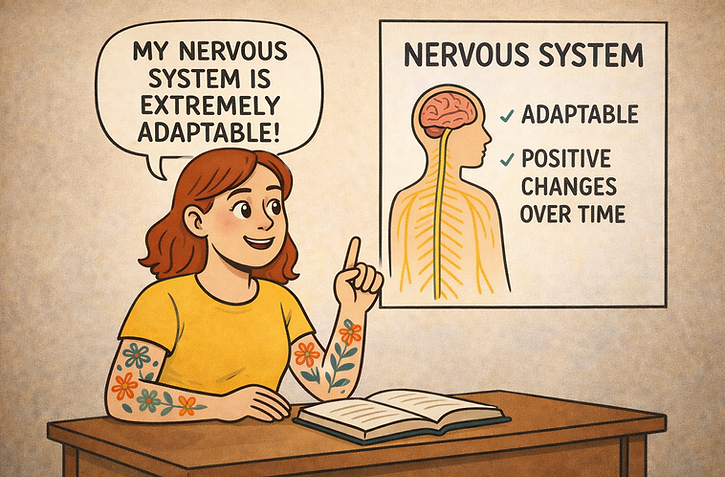
Capítulo 3: El sistema nervioso y el dolor


Capítulo 4: Reentrenamiento cerebral

Capítulo 5: Cambiando tu diálogo interno


Capítulo 6: El dolor es real y necesario


Capítulo 7: Los efectos de la cirugía y la inflamación sobre el dolor.

Capítulo 8: Dolor agudo y crónico


Capítulo 9:
Los efectos de la radioterapia sobre el dolor
El dolor tras la radioterapia es algo más complejo que el dolor postoperatorio. Es posible que sus médicos le hayan comentado que la radiación es un tratamiento que perdura. Si bien la energía radiactiva se aplica únicamente durante la radioterapia activa, sus efectos en los tejidos pueden persistir durante 1 o 2 años después de finalizar el tratamiento. Durante este tiempo, puede experimentar dolores punzantes o molestias intermitentes. Usted no es radiactivo, pero los efectos residuales de la radiación en los tejidos tratados pueden seguir provocando síntomas durante bastante tiempo.


Capítulo 10: Cómo obtener ayuda para el dolor después de la radioterapia

All images contained within BrCAcademy’s About Breast Cancer & Pain were generated using artificial intelligence and are the exclusive intellectual property of BrCAcademy. The original written and educational content was created by Jodi Winicour, PT, CMT, CLT-LANA, and is likewise the exclusive property of BrCAcademy. All academic and scholarly sources referenced in the development of this educational material are cited in the accompanying reference list.
Armstrong, S. A., & Herr, M. J. (2025). Physiology, nociception. In StatPearls. StatPearls Publishing.
Athnaiel, O., Cantillo, S., Paredes, S., & Knezevic, N. N. (2023). The role of sex hormones in pain-related conditions.
International Journal of Molecular Sciences, 24(3), 1866.
Booth, J., Moseley, G. L., Schiltenwolf, M., Cashin, A., Davies, M., & Hübscher, M. (2017). Exercise for chronic
musculoskeletal pain: A biopsychosocial approach. Musculoskeletal Care, 15(4), 413–421.
Boyd, B. S. (2023). Bodily relearning: Reteaching bodily protection responses through insight and movement
exploration. Noigroup Publications.
Brett Whalen, L., Zachary Wright, W., Kundur, P., Angadi, S., & Modesitt, S. C. (2022). Beneficial effects of exercise on
chemotherapy-induced peripheral neuropathy and sleep disturbance: A review of literature and proposed mechanisms.
Gynecologic Oncology Reports, 39, 100927.
Brown, B. (2015). Rising strong: The reckoning, the rumble, the revolution. Spiegel & Grau.
Butler, D. S., & Moseley, G. L. (2018). Explain pain (2nd ed.). Noigroup Publications.
Dizdar, O., Ozçakar, L., Malas, F. U., Harputluoglu, H., Bulut, N., Aksoy, S., Ozisik, Y., & Altundag, K. (2009). Sonographic
and electrodiagnostic evaluations in patients with aromatase inhibitor-related arthralgia. Journal of Clinical Oncology,
27(30), 4955–4960.
Gold, M. S., & Gebhart, G. F. (2010). Nociceptor sensitization in pain pathogenesis. Nature Medicine, 16, 1248–1257.
Hyder, T., Marino, C. C., Ahmad, S., Nasrazadani, A., & Brufsky, A. M. (2021). Aromatase inhibitor–associated
musculoskeletal syndrome: Understanding mechanisms and management. Frontiers in Endocrinology, 12, 713700.
Khoury, A. L., Keane, H., Varghese, F., et al. (2021). Trigger point injection for post-mastectomy pain: A simple
intervention with high rate of long-term relief. NPJ Breast Cancer, 7(1), 123.
Kim, S., Chen, N., & Reid, P. (2024). Current and future advances in practice: Aromatase inhibitor-induced arthralgia.
Rheumatology Advances in Practice, 8(2), rkae024.
Kleckner, I. R., Kamen, C., Cole, C., et al. (2019). Effects of exercise on inflammation in patients receiving chemotherapy:
A nationwide NCORP randomized clinical trial. Supportive Care in Cancer, 27(12), 4615–4625.
Li, Q., Gao, E. L., Yang, Y. L., Hu, H. Y., & Hu, X. Q. (2012). Traumatic neuroma in a patient with breast cancer after
mastectomy: A case report and review of the literature. World Journal of Surgical Oncology, 10, 35.
Lowe, D. B., & Storkus, W. J. (2011). Chronic inflammation and immunologic-based constraints in malignant disease.
Immunotherapy, 3(10), 1265–1274.
Molinaro, R., Corbo, C., Livingston, M., Evangelopoulos, M., Parodi, A., Boada, C., Agostini, M., & Tasciotti, E. (2018).
Inflammation and cancer: In medio stat nano. Current Medicinal Chemistry, 25(34), 4208–4223.
Moraes, L. J., Miranda, M. B., Loures, L. F., Mainieri, A. G., & Mármora, C. H. C. (2018). A systematic review of
psychoneuroimmunology-based interventions. Psychology, Health & Medicine, 23(6), 635–652.
Regent-Smith, A. J., Childers, E. J., Dzwierzynski, W. W., & Morgan, A. L. (2023). Incidence and treatment efficacy of
trigger finger in the breast cancer population on aromatase inhibitors. Hand, 18(2), 250–253.
Romero, S. A. D., Su, H. I., Satagopan, J., et al. (2020). Clinical and genetic risk factors for aromatase inhibitor-
associated arthralgia in breast cancer survivors. The Breast, 49, 48–54.
Subnis, U. B., Starkweather, A. R., McCain, N. L., & Brown, R. F. (2014). Psychosocial therapies for patients with cancer: A
current review of interventions using psychoneuroimmunology-based outcome measures. Integrative Cancer
Therapies, 13(2), 85–104.
Tyll, M. D., Goodkin, K., Blaney, N. T., Baldewicz, T. T., Hunt, J. D., & Asthana, D. (2000). Theory-driven interventions in
psychoneuroimmunology and HIV-1 infection. CNS Spectrums, 5(5), 25–32.
Van der Kolk, B. A. (2014). The body keeps the score: Brain, mind, and body in the healing of trauma. Penguin Books.
Yu, K., Portes, P., Morris, G. S., Huang, L., Felix, E. R., Farkas, G. J., Molinares, D., & Tiozzo, E. (2024). The role of
exercise in aromatase inhibitor-induced arthralgia. PM&R, 16(12), 1406–1416.
Zoffness, R. (2020). The pain management workbook: Powerful CBT and mindfulness skills to take control of pain and
reclaim your life. New Harbinger Publications.