
Breast cancer education for patients — and the healthcare professionals who care for them.
Learn on your own. Explore together during a treatment session. Share trusted resources with someone you care for.
About Breast Cancer & Pain
We are so glad you are here!
This neurobiology of pain education was created with you in mind. Through my work as an oncology physical therapist—and through my own lived experience with excessive chest pain after preventive mastectomies, chronic migraines, and more than 20 years of leg pain following a back injury—I have learned just how complex and personal pain can be. Those experiences have shaped both my clinical practice and my passion for learning, teaching, and sharing what truly helps. My goal is to use what I have uncovered to reduce suffering and offer hope to those navigating breast cancer, with and without persistent pain.
This education is meant to build step by step, so we encourage you to start at the beginning and move through it in order. A first read-through usually takes about 30–45 minutes. You may find it helpful to return to certain chapters over time—especially as the ideas and examples begin to land in new ways. Changing how we think about pain takes time, and that is completely normal. Be patient with yourself. Be kind to yourself. Learning often happens through repetition, so come back as often as you need. We’d love to see you again and hear your stories along the way.
All of us at BrCAcademy are wishing you a healthy, meaningful, and supported recovery.
Always, Jodi

Chapter 1:
Pain is Necessary


Chapter 2: Context and Pain


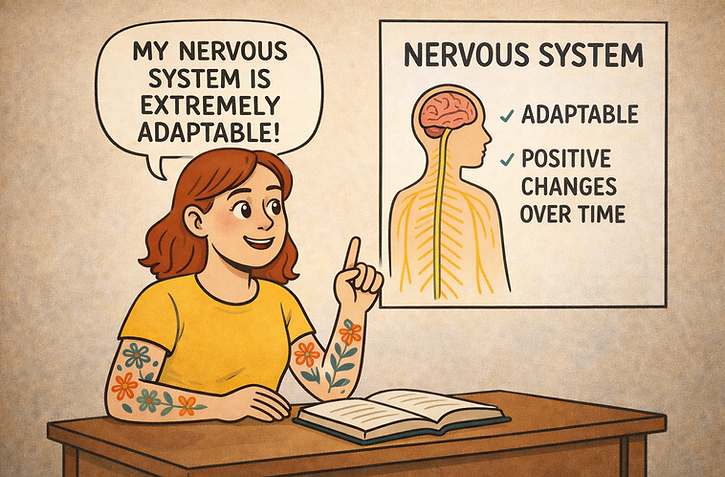
Chapter 3: Your Nervous System and Pain


Chapter 4: Brain Retraining

Chapter 5: Changing Your Self-Talk


Chapter 6: Pain is Real and Necessary


Chapter 7: The Effects of Surgery & Inflammation on Pain

Chapter 8: Acute & Chronic Pain


Chapter 9:
The Effects of Radiation Therapy on Pain
Pain after radiation therapy is a bit trickier than post-surgical pain. You may have heard from your caregivers that radiation is the gift that keeps on giving. While radioactive energy is applied only during your active radiation treatments, its effects on the tissues can persist for 1–2 years after treatment ends. During this time, you may experience intermittent sharp, shooting pains or discomfort. You are not radioactive, but the lingering effects of radiation on the treated tissues can continue to cause symptoms for quite some time.


Chapter 10: Getting Help for Pain after Radiation

All images contained within BrCAcademy’s About Breast Cancer & Pain were generated using artificial intelligence and are the exclusive intellectual property of BrCAcademy. The original written and educational content was created by Jodi Winicour, PT, CMT, CLT-LANA, and is likewise the exclusive property of BrCAcademy. All academic and scholarly sources referenced in the development of this educational material are cited in the accompanying reference list.
Armstrong, S. A., & Herr, M. J. (2025). Physiology, nociception. In StatPearls. StatPearls Publishing.
Athnaiel, O., Cantillo, S., Paredes, S., & Knezevic, N. N. (2023). The role of sex hormones in pain-related conditions.
International Journal of Molecular Sciences, 24(3), 1866.
Booth, J., Moseley, G. L., Schiltenwolf, M., Cashin, A., Davies, M., & Hübscher, M. (2017). Exercise for chronic
musculoskeletal pain: A biopsychosocial approach. Musculoskeletal Care, 15(4), 413–421.
Boyd, B. S. (2023). Bodily relearning: Reteaching bodily protection responses through insight and movement
exploration. Noigroup Publications.
Brett Whalen, L., Zachary Wright, W., Kundur, P., Angadi, S., & Modesitt, S. C. (2022). Beneficial effects of exercise on
chemotherapy-induced peripheral neuropathy and sleep disturbance: A review of literature and proposed mechanisms.
Gynecologic Oncology Reports, 39, 100927.
Brown, B. (2015). Rising strong: The reckoning, the rumble, the revolution. Spiegel & Grau.
Butler, D. S., & Moseley, G. L. (2018). Explain pain (2nd ed.). Noigroup Publications.
Dizdar, O., Ozçakar, L., Malas, F. U., Harputluoglu, H., Bulut, N., Aksoy, S., Ozisik, Y., & Altundag, K. (2009). Sonographic
and electrodiagnostic evaluations in patients with aromatase inhibitor-related arthralgia. Journal of Clinical Oncology,
27(30), 4955–4960.
Gold, M. S., & Gebhart, G. F. (2010). Nociceptor sensitization in pain pathogenesis. Nature Medicine, 16, 1248–1257.
Hyder, T., Marino, C. C., Ahmad, S., Nasrazadani, A., & Brufsky, A. M. (2021). Aromatase inhibitor–associated
musculoskeletal syndrome: Understanding mechanisms and management. Frontiers in Endocrinology, 12, 713700.
Khoury, A. L., Keane, H., Varghese, F., et al. (2021). Trigger point injection for post-mastectomy pain: A simple
intervention with high rate of long-term relief. NPJ Breast Cancer, 7(1), 123.
Kim, S., Chen, N., & Reid, P. (2024). Current and future advances in practice: Aromatase inhibitor-induced arthralgia.
Rheumatology Advances in Practice, 8(2), rkae024.
Kleckner, I. R., Kamen, C., Cole, C., et al. (2019). Effects of exercise on inflammation in patients receiving chemotherapy:
A nationwide NCORP randomized clinical trial. Supportive Care in Cancer, 27(12), 4615–4625.
Li, Q., Gao, E. L., Yang, Y. L., Hu, H. Y., & Hu, X. Q. (2012). Traumatic neuroma in a patient with breast cancer after
mastectomy: A case report and review of the literature. World Journal of Surgical Oncology, 10, 35.
Lowe, D. B., & Storkus, W. J. (2011). Chronic inflammation and immunologic-based constraints in malignant disease.
Immunotherapy, 3(10), 1265–1274.
Molinaro, R., Corbo, C., Livingston, M., Evangelopoulos, M., Parodi, A., Boada, C., Agostini, M., & Tasciotti, E. (2018).
Inflammation and cancer: In medio stat nano. Current Medicinal Chemistry, 25(34), 4208–4223.
Moraes, L. J., Miranda, M. B., Loures, L. F., Mainieri, A. G., & Mármora, C. H. C. (2018). A systematic review of
psychoneuroimmunology-based interventions. Psychology, Health & Medicine, 23(6), 635–652.
Regent-Smith, A. J., Childers, E. J., Dzwierzynski, W. W., & Morgan, A. L. (2023). Incidence and treatment efficacy of
trigger finger in the breast cancer population on aromatase inhibitors. Hand, 18(2), 250–253.
Romero, S. A. D., Su, H. I., Satagopan, J., et al. (2020). Clinical and genetic risk factors for aromatase inhibitor-
associated arthralgia in breast cancer survivors. The Breast, 49, 48–54.
Subnis, U. B., Starkweather, A. R., McCain, N. L., & Brown, R. F. (2014). Psychosocial therapies for patients with cancer: A
current review of interventions using psychoneuroimmunology-based outcome measures. Integrative Cancer
Therapies, 13(2), 85–104.
Tyll, M. D., Goodkin, K., Blaney, N. T., Baldewicz, T. T., Hunt, J. D., & Asthana, D. (2000). Theory-driven interventions in
psychoneuroimmunology and HIV-1 infection. CNS Spectrums, 5(5), 25–32.
Van der Kolk, B. A. (2014). The body keeps the score: Brain, mind, and body in the healing of trauma. Penguin Books.
Yu, K., Portes, P., Morris, G. S., Huang, L., Felix, E. R., Farkas, G. J., Molinares, D., & Tiozzo, E. (2024). The role of
exercise in aromatase inhibitor-induced arthralgia. PM&R, 16(12), 1406–1416.
Zoffness, R. (2020). The pain management workbook: Powerful CBT and mindfulness skills to take control of pain and
reclaim your life. New Harbinger Publications.